A bank that understood Hong Konger's actual financial goals.
Designing the Goals feature — and the savings culture — of one of Hong Kong's first licensed virtual banks, from conception to launch.
RoleUX Designer
Full role scopeSave · Spend · Growth · Onboarding · IAMThis case study focuses on Save
PlatformiOS · Android
15%Goals adoption rate target within first 3 months
25%Savings rule setup rate per Goal created
+20%Active user rate Goals vs. no Goals
Context
Building a bank from the ground up — inside a regulatory sandbox.
Mox Bank launched in September 2020 as one of Hong Kong's first virtual banks, regulated under the Hong Kong Monetary Authority. I joined early in the design process, working across Onboarding, Save, Spend, Growth, and Identity & Access Management — essentially the full product surface of a bank being built from scratch.
This case study focuses on Goals, the centrepiece of the Save proposition — but the story starts with a hard constraint the whole team had to design around.
The HKMA required that no entirely new financial product could launch with the bank. Every feature had to be derived from existing approved banking services. That constraint, rather than limiting us, pushed us to find meaningful innovation in how we presented familiar instruments — and that turned out to be the right problem to solve.
Who I worked withHead of Accounts & DepositsProduct OwnersProduct Delivery (PM)2× Front-end EngineersVisual DesignerMotion DesignerUX WriterMarketing
The brief
A bank built around the Hong Kong young professional.
The executive direction was specific: Mox would be Hong Kong's bank for young professionals — a generation that travels, that dreams big, that lives in one of the world's most expensive cities, and that has grown up expecting more from technology than traditional banks were offering.
The proposition wasn't to beat existing banks on interest rates. It was to understand this customer's life — their short-term wants and long-term goals — and build a bank that actively helped them make progress toward both. Small wins matter as much as big ones. A trip to Tokyo matters. A new iPhone matters. These are as real as retirement.
The business logic reinforced this. A savings product that truly served customers' goals would also build the kind of daily engagement that kept them coming back. We weren't just holding deposits — we were designing a habit loop, where setting, progressing toward, and achieving Goals gave users a reason to return to the app with purpose. Automated savings rules were central to this: a customer with an active rule was an inherently more retained one — they had a target to track, a plan in motion, a bank that felt like it was working for them.
Research & Discovery
They weren't unmotivated. They were stuck.
Before the bank's conception, R/GA conducted quantitative research on Hong Kong saving behaviours. Once I joined, I ran iterative qualitative research every two sprints — designing, moderating, and synthesising user interviews and usability tests with mid- to high-fidelity prototypes.
Average savings rate — Hong KongSource: Pre-bank quantitative research (R/GA)
18%of annual income saved on average
Saves regularly
72%
Has a monthly savings target
58%
Strictly follows their target
21%
Has a specific savings goal in mind
44%
The gap between "saves regularly" and "strictly follows their target" told us everything. The intent was there. The system wasn't.
But how people saved was fragile: a salary account for daily in/out, a second for petty cash, a third tucked away for long-term saving — manual transfers between them, across multiple banks, testing willpower every single time.
And the goals themselves were either impossibly large or dangerously vague:
Buying a flat in Hong Kong requires HK$7–9M for an average flat in a non-prime district. For most young professionals, that goal is so far out of reach it becomes paralysing — they stop saving for anything.
Retirement feels abstract. Without an immediate trigger, it's easy to defer.
Monthly targets existed in people's heads, but weren't being followed — purchase impulse consistently beat the intention to save.
They weren't lazy. They were stuck between goals too big to feel achievable and goals too vague to feel worth it.
The most common pain points that surfaced across sessions: overspending in certain categories without realising until too late; savings plans at traditional banks that locked you in with punishing exit penalties; low returns that made saving feel pointless; and a total lack of visibility across accounts at different banks.
Design Principles
Five ideas that shaped the design.
Working closely with the Head of Accounts & Deposits and the product team, we distilled the research into five design principles — each one addressing a specific failure mode in how people save.
1
Make it yours
We let users personalise their Goals with a name and an avatar from their own photos. The account stopped being a bank product and started feeling like their own space. Ownership changes how we relate to a balance — the Endowment Effect, applied to saving.
2
Start small, mean it
Instead of pointing only to retirement or property, we surfaced short-term, joyful targets: a trip to Tokyo, a new gadget, a birthday fund. Small goals are achievable. Achievable goals get started. Getting started builds the habit.
3
Make the target real
Goal setting works when the target is specific and believable. As users set an amount and a date, we showed them whether the target was realistic — and suggested adjustments if it wasn't. A plan you've stress-tested is a plan you'll follow through on.
4
Show the journey, not just the balance
A moving progress bar is a small thing. But seeing yourself get closer to a specific target matters more than watching a number grow. We designed progress visualisation that kept the end goal in view at every check-in.
5
Remove the willpower test
Every manual transfer tests willpower at exactly the wrong moment — when you're most tempted to spend. We built automation: recurring transfers from Mox or pulled from external accounts via eDDA. The saving happens without a daily decision being required.
Design · Create a Goal
A four-step flow built around momentum, not obligation.
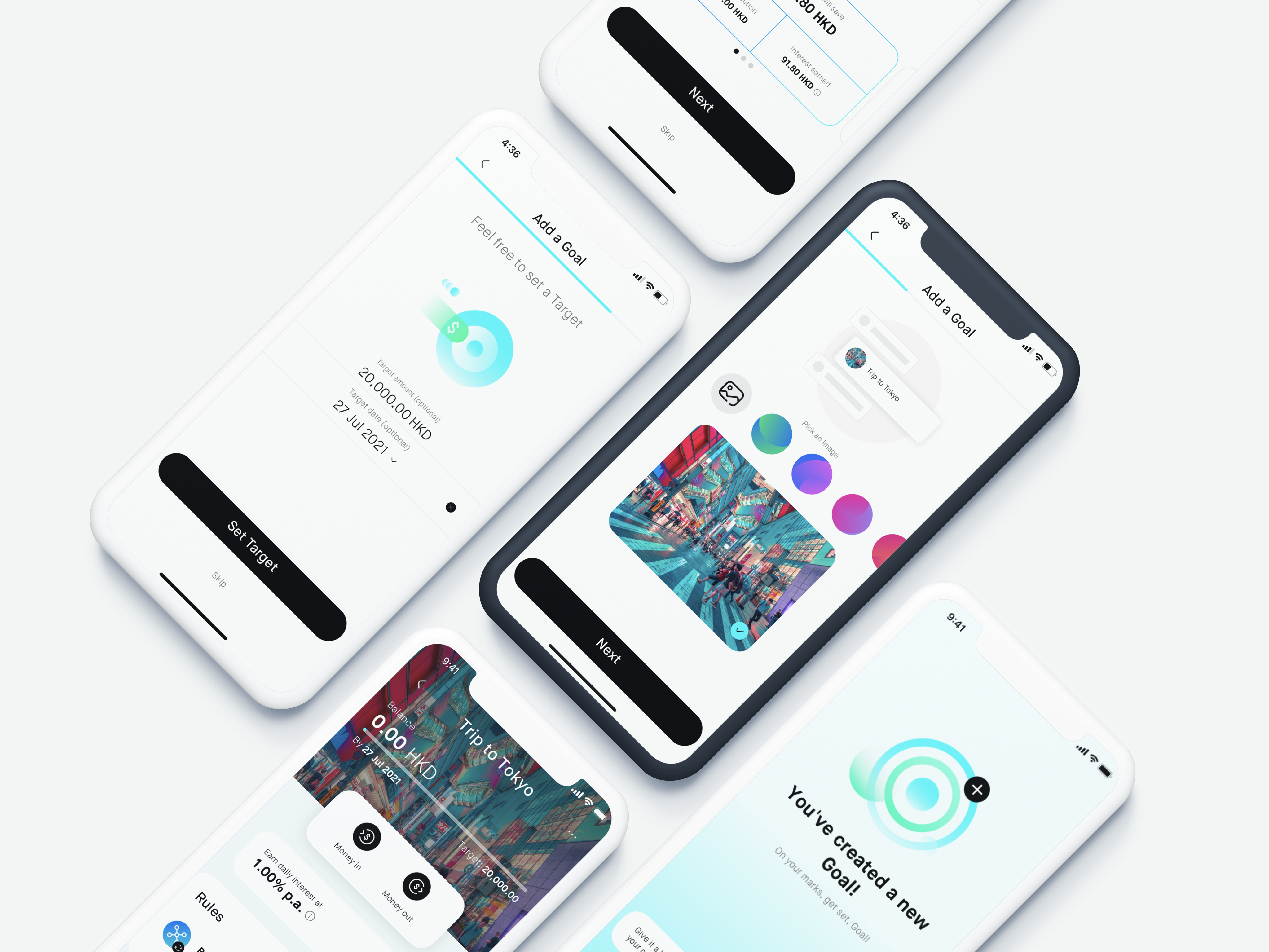
The goal creation flow was the most carefully considered piece of the experience. The order of steps was deliberate — we wanted users to feel inspired before they felt committed.
0
Give them a starting point
Before asking for any input, we showed Goal inspirations — a trip, a gadget, a gift. Not to be prescriptive, but to spark. Users who arrived with a vague idea of "saving more" could see their own goals reflected back at them.
1
Make it personal
Name the Goal. Set an avatar from their photo library. By the end of this step, the account feels like theirs — not a sub-account in a bank's system, but a named intention they own.
2
Set a realistic target
Optional target amount and date — but if they set both, we calculated whether it was achievable. If they were setting themselves up to fail, we told them gently and suggested adjustments. Not judgement; guidance.
3
Automate, and forget about it
Set a savings rule: recurring transfer from the Mox main account or pull from an external bank via eDDA. Once automated, the Goal grows without the user having to remember to act — removing willpower as a variable.
Prototype walkthrough — full Goal creation flow, from inspiration to first automated saving rule.
A note on loading time — one of those details that only surfaces in production: in our UAT environment, Goals were created in about 2 seconds. In production, that stretched to 5 seconds — on the edge of the threshold where users feel disconnected from their action. Rather than waiting for an infrastructure fix, we designed a loading animation that gave the moment some ceremony. The wait became part of the experience. I'd used the same principle in Onboarding, where up to 30 seconds of background processing was anticipated — the motion designer's animations absorbed it, and users felt like something meaningful was happening, not that they were waiting.
Process
Research-led, iteration-tested, shipped with care.
The project ran on a two-sprint research rhythm. Every two sprints, I designed, ran, and debriefed a round of qualitative sessions — user interviews paired with usability tests on mid- to high-fidelity prototypes. Each round informed the next design iteration, which went straight back into testing.
Early design explorations ranged widely. We tested concepts around visual savings "buckets," calendar-based goal timelines, social saving with friends, and gamified progress mechanics. Some of these sparked strong reactions — in both directions. The sessions were less about validating a direction and more about understanding the emotional texture of saving: what made it feel meaningful, what made it feel like a chore.
The most clarifying insight wasn't a data point. It was watching a user dismiss a savings calculator mid-session because the target amount felt "too far away to start now." We stopped designing for the goal and started designing for the first step.
That shift — from the destination to the starting point — led directly to the inspiration-first flow. By showing achievable, joyful examples before asking for any commitment, we lowered the activation energy for creating a first Goal. Later rounds of testing confirmed that the order of steps mattered as much as the steps themselves.
Throughout, I worked closely with the visual designer on the UI detail — the avatar personalisation, the progress treatment — and the motion designer on how animations could mark moments of progress and achievement without feeling gratuitous. The UX writer shaped the tone on the inspiration screen, which had to feel encouraging without being patronising. Each of those collaborations shaped the outcome as much as the structural design decisions did.
Stakeholder alignment ran in parallel. I facilitated an Inception Workshop with product owners, engineers, and the Head of Deposits to share research findings and map a shared understanding of the user journey. Getting everyone in the same room, reading from the same research, made the subsequent design reviews go faster and the eventual delivery go smoother.
Outcome
Goals shipped — and gave us a feedback loop worth following.
Goals launched as one of Mox's signature Save features. Before launch, the whole team aligned on a clear set of success metrics to measure whether the design was working — not just whether it was used.
15%Goals adoption rate target within first 3 months
25%Savings rule (automation) setup rate per Goal created
+20%Active user rate — users with Goals vs. without
Post-launch, the data opened new questions worth designing for: when do customers create their first Goal after onboarding — and are there seasonal patterns? What do people name their Goals? Are target dates being hit? How does automation uptake correlate with goal completion over time?
Those questions fed the next iterations — improving the inspiration examples to lift adoption from 13% toward 20%+, designing milestone celebrations, and building re-engagement nudges for Goals that had stalled. The product didn't stop at launch; it became a system we could learn from and improve.
Reflection
What I carry from this.
Working at Mox was where I learned what it means to build a product people trust from scratch. When a bank is new, every onboarding screen, every balance view, every error state is part of the argument for why someone should trust you with their money. There's no legacy to coast on. The design has to earn it.
Goals specifically taught me that the best user insights often reframe the brief entirely. The shift that mattered most — from designing for the goal to designing for the first step — only emerged from being in the room with users, watching where confidence broke down. No amount of desk research would have surfaced it.
And I came away with a genuine appreciation for the team around me. The motion designer's animations made progress feel alive in ways a static prototype couldn't describe. The UX writer's copy on the inspiration screen was what made users feel seen. Our engineers found creative solutions within real infrastructure constraints. Good design at this scale is genuinely collective — my job was to hold the vision and make the space for everyone to do their best work within it.