Design leadership as a system, not a style.
When I joined Plum, the entire design function had left — from mid-weight designers to the Head of Design. There was no team to inherit. My mandate was to rebuild from nothing: hiring the right people, onboarding them into an unstable product context, and building the rituals and culture that would let a new team operate with confidence — fast.
Over two years I grew the team to seven, established PED collaboration processes that built genuine cross-functional trust, and extended design's influence org-wide. All while staying hands-on — designing, reviewing, and shipping alongside the team throughout.
Empowerment, leading by example, empathy.
Cross-functional Squads
Designers embedded in product squads — working directly with PMs and engineers, with the authority to make decisions and own their projects end-to-end.
Support
Different seniority levels and personalities need different support. The goal was to provide the right resources and guidance — and to build a culture where the team supports each other as default, not just in moments of difficulty.
Ownership
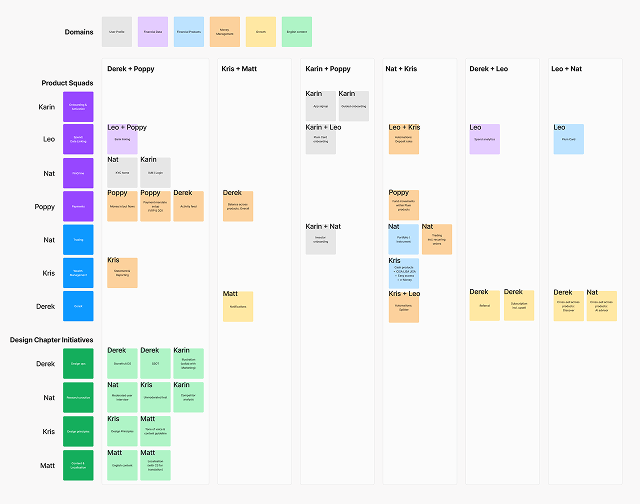
Designers own e2e user journeys and associated company metrics — driving cross-squad initiatives from a user-centred position, with real accountability.
Strong Work Ethic
Be punctual, meet your own deadlines, come prepared. The standard you model is the standard the team adopts.
Open Communication
Foster dialogue and approachability. Acknowledge good work clearly; address improvement areas in ways that encourage growth, not defensiveness.
Strategic Vision
Make the team's work visible in the context of company goals. Everyone should understand how their contribution matters beyond their own squad.
Continuous Learning
I set up a shared resource library and monthly luncheon sessions to make learning a team habit. Staying current is a collective responsibility.
Celebrate Successes
Recognise individual and team wins — in 1:1s, team channels, and career progression. A motivating environment is built deliberately, not by accident.
User-centricity
Speak to users directly — regardless of seniority or schedule. I talk to users every quarter and held the team to the same standard.
Ways of working, high-performing culture, collaboration.
Product ↔ Design Collaboration
Product–Design collaboration framework- Clear process for design to collaborate effectively with product
- Defined discovery, ideation, and design phases with explicit handoffs
- Sprint planning and management introduced to the product–design process
Feedback Culture
Design review processStructured reviews and retros embedded into every sprint — predictable feedback moments, not last-minute critiques.
Clear Goals
Competency matrix established across the design discipline. Personal goals set with each team member against measurable outcomes. Quarterly AMA sessions with PED leadership for transparency and strategic alignment.
Sense of Urgency & Warmth
Speed and care aren't opposites. Swift execution and iterative progress, inside a genuinely supportive environment. Clear priorities, quick wins, and momentum — without burning people out.
Cross-squad Collaboration
When designers own user journeys spanning multiple squads, collaboration becomes structural. Resource planning accounts for seniority, priorities, individual strengths, and dynamics — not just headcount.
Building and growing the design team.
Hiring
Hired across all levels — associate to senior — assessed against a consistent bar for craft, communication, and commercial awareness.
Skillset Mix
Complementary skills, not uniform ones:
- Research and synthesis
- Commercial acumen
- Complex systems and IA
- Visual craft and interaction
Organisation Structure
Structure organised around initiative and domain ownership, experience level, and team dynamics — squads that are effective and stable, not just resourced.
Performance Management
Competency frameworkTrain people well enough so they can leave. Treat them well enough so they don't have to.
Clear visibility at every level — what's expected now, what the next level looks like, and how to get there.
Stay in the Details
Design leadership at a scale-up means balancing delegation with staying plugged in. Delegating without staying connected is how quality slips invisibly.
Design culture and user advocacy beyond the design team.
The most durable design impact is measured in how the whole organisation thinks about users — not in the number of screens shipped.
Design Principles
Shared decision-making framework used across PED, Customer Service, Compliance, and FinCrime Ops — bringing disciplines into a united front toward building long-term user trust.
User Advocacy
Speaking to users is mandatory — not optional. Interviews structured to uncover challenges and opportunities, not just validate what we'd already decided to build.
Research Practices
Discovery research brought into pre-strategy stages — before roadmaps locked — to build a shared user understanding org-wide. Day-to-day design validations embedded as a continuous habit, not a separate phase.